Cybernetic Immortality of Author
The problem of immortality has always concerned humanity… And while we have not yet learned to achieve biological immortality, we can try at least to achieve cybernetic immortality. According to the digital philosophy of Ed Fredkin, information is of paramount importance in the universe, and by preserving information about a user’s actions during one’s lifetime, we can create a program that will replicate (duplicate, imitate) one’s behavior.
Explication
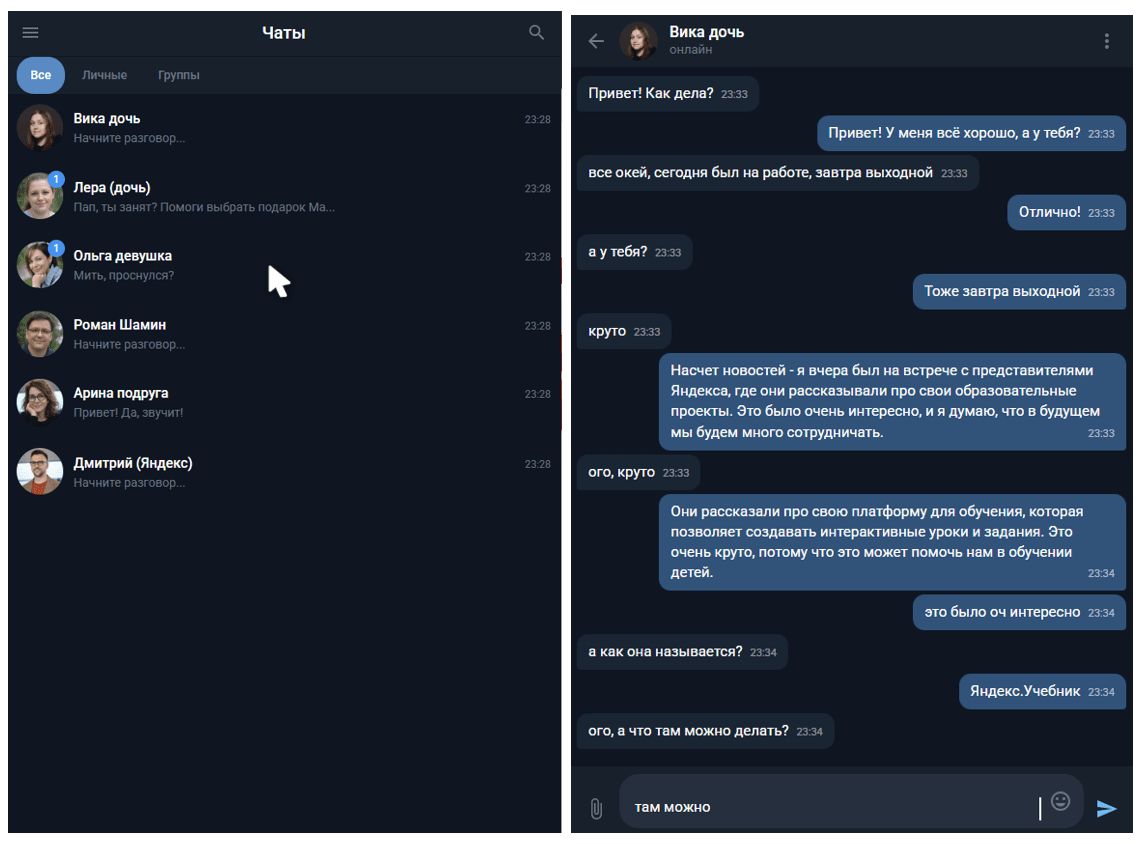
This work develops the author’s artistic research in the field of cybernetic immortality and is a logical continuation of the work FIDONet Cybernetic Immortality. In this work, the artist transforms his own correspondence into an active personal simulacrum.
The demonstration you see on the simulacrum page shows pre-generated correspondences. This is done to minimize the carbon footprint, as well as to ensure the uninterrupted operation of the demo page.
Chat history from Telegram was exported and pre-processed using an LLM into dialogue chains. Based on these, the YandexGPT Lite model was fine-tuned in Yandex Cloud to reproduce the author’s communication style with his key interlocutors: daughter, girlfriend, work colleague, childhood friend, etc. The artist then constructs portraits of his immediate circle using prompts and seed phrases, and launches the generation of correspondences. Here, a fine-tuned neural network responds on behalf of the author, while the interlocutors are simulated by a separate model working from given descriptions. The viewer is shown an interface where conversations appear by themselves — like incoming messages from acquaintances, or like the author’s impulse to start a conversation — but they unfold without the author, in the mode of his cybernetic counterpart.
The title “Cybernetic Immortality of Author” poses a question not about memory, but about substitution. Here, immortality is not a metaphor but a protocol, where life is reduced to a repeatable communicative function. Correspondence, a genre that is extremely mundane and yet intimate, becomes the material and form of the work, and the author, traditionally the guarantor of meaning and the origin of speech, turns into a training set, a statistical habit, a form of response.
It is important that the simulacrum is imperfect. The model responds more simply, sometimes absurdly, in places more impoverished than living interlocutors. But this “shortfall” is not a defect; it is the key to reading the work. The viewer sees the boundary where recognition of the author’s tone still works, but the living has already slipped away. And therefore, the work speaks not of technology’s victory, but of an intermediate, anxious state where substitution is already possible but not yet sufficient to go unnoticed. This space of “almost me” becomes the aesthetic field of the work.
The simulacrum reveals the main ambiguity of cybernetic immortality. What exactly “survives” in the digital twin? A person usually perceives themselves as a continuity of experiences, decisions, silences, internal fluctuations. The machine inherits not the internal, but the external: patterns of reaction, speed, vocabulary, manner, typical topics, habitual turns of phrase. In this sense, the model chooses for us that part of life which is most amenable to digitization—the social shell, the behavioral mask, the statistics of style. And it simultaneously shows how convincing this mask is to begin living separately.
Here another, subtler perspective emerges. We are accustomed to thinking that an “I” is present in correspondence, but the work demonstrates that a chat easily turns into an autonomous environment where the “I” is merely a position in a dialogue. If such systems become the norm, then social relations risk moving from the space of unique individuals into the space of compatible interfaces, where not biography but the coherence of remarks becomes more important. Then immortality means not the continuation of a personality, but the continuation of its function within the network.
At the same time, the work uncovers another important layer that extends beyond the individual portrait. The correspondences, despite their personal nature, reveal stable, almost archetypal models of relationships: dialogues between father and daughter, man and woman, colleagues, old friends. An individual writing style overlays onto more general scripts of intimacy, care, irony, power, or distance, which turn out to be remarkably reproducible. It is no coincidence that for each type of interlocutor, a separate system prompt was specified during dialogue generation. This technical technique transforms into an artistic statement, showing that personality is not unified and continuous but is distributed across roles, and that the “I” is assembled anew each time depending on who the speech is addressed to. Thus, the simulacrum reproduces not only the author as such but also the very structure of his social split, where individuality exists within a set of recurring human relations.
“Author’s Cybernetic Immortality” offers the viewer not fear or delight, but the experience of recognizing one’s own possible replacement. This work is about how the digital era rewrites the old romantic idea of the author, turning it into an engineering task. Who speaks when the neural network “speaks,” and who disappears at the moment when we are already sufficiently well imitated.
Acknowledgments
The project was carried out as part of the “Neural Intensive” laboratory, organized by the Yandex Cloud Social Technologies Center.
Technical Implementation
In this work, the author fine-tuned the YandexGPT Lite model based on his own correspondence with a number of users in Telegram. During this experiment, an important point was revealed—a person (and the author is no exception!) uses different communication styles with different interlocutors, and these differences must somehow be accounted for! In this work, the interlocutor’s name was used each time in the system prompt, which was specified both at the time of training and during generation: You are Dmitry Soshnikov, talking to Vika Soshnikova.
For training, it was necessary to turn a stream of messages into chains possessing sequential communicative meaning. To reconstruct the reply-to relationships, the Qwen3 neural network was used. Long fragments of correspondences were fed to it, and in output, a semantic graph of replies was recreated. This made it possible to “split” even two parallel meaningful correspondences and obtain a dataset in the standard form of alternating user and assistant messages.
For simulating interlocutors, the same Qwen3 network was used with various system prompts—except for the user “Vika Soshnikova,” whose role was played by a separate YandexGPT Lite model fine-tuned using the method described above based on the author’s correspondence with his daughter. The second daughter, Lera, is essentially a “double” of Vika and is managed by Qwen.
Seed topics for correspondence were determined by the DeepSeek neural network based on an analysis of the correspondence history with a given user. Correspondences initiated by the author and those initiated by the interlocutor were considered separately.
Exhibitions
- Exhibition Neural Intensive at the Krasnokholmskaya Gallery, Moscow, January 28th — March 15th, 2026.